
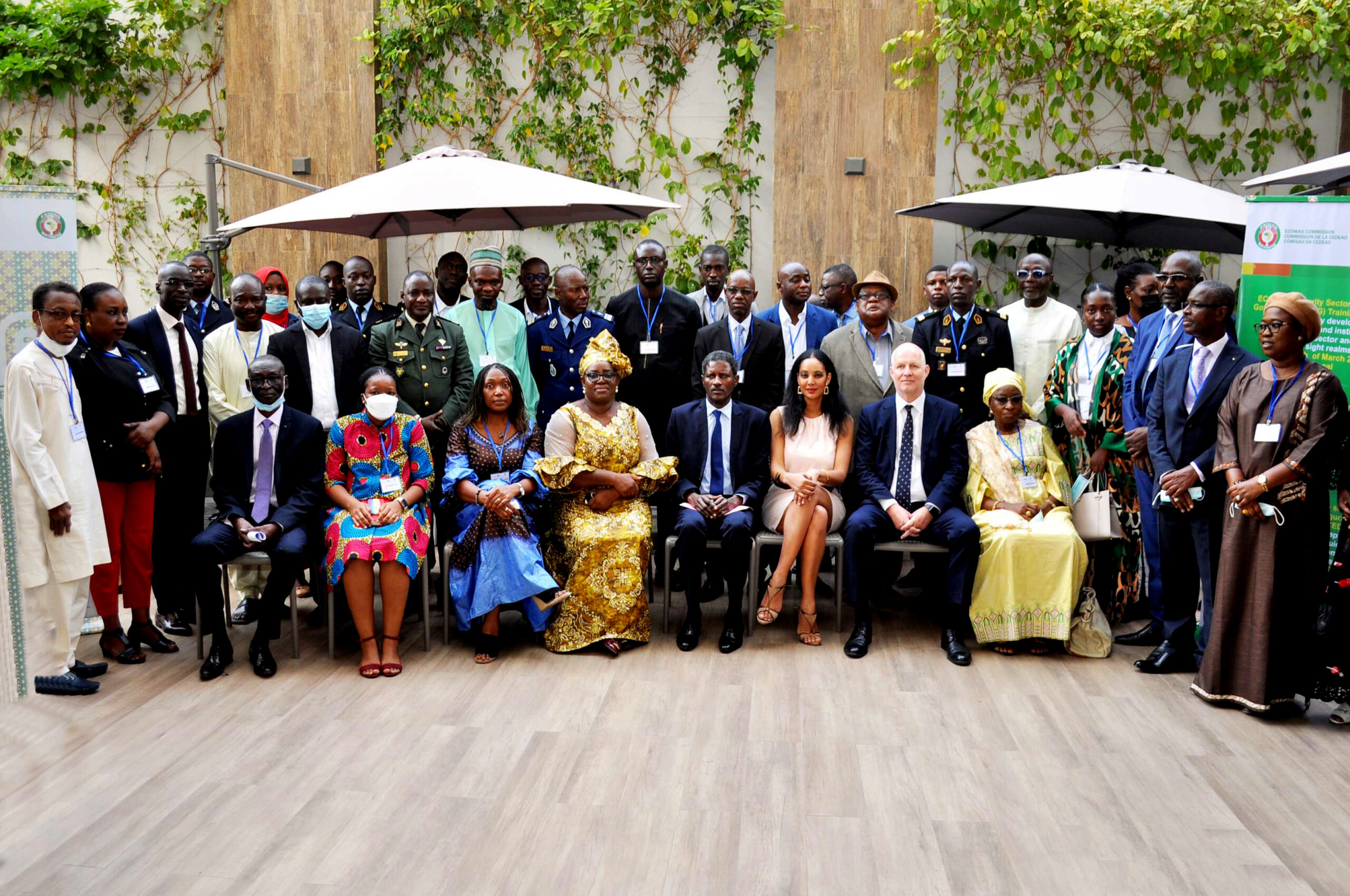
 The concluding workshop in the pilot series of national workshops to disseminate the ECOWAS Policy Framework for Security Sector Reform and Governance has been launched by the African Security Sector Network and its partners at Le Ndiambour Hôtel et Résidence in Dakar, Senegal. From 14th to 16th March 2022, cross-sectoral stakeholders from relevant ministries, agencies, national institutions and organizations in Senegal will engage in critical deliberations on Security Sector Reform and Governance (SSRG) in the ECOWAS region, with emphasis on Senegal.
This workshop marks the end of phase one of the project supported by the GIZ-ECOWAS Peace and Security Architecture and Operations (EPSAO) project to disseminate the ECOWAS Policy Framework for SSRG in member states, with the aim of promoting awareness of the ECOWAS Policy Framework as mandated by the ECOWAS Authority of Heads of State and Government. The project is co-funded by the European Union and the German Federal Ministry for Economic Development and Cooperation (BMZ). Prior to the workshop in Senegal, the ASSN had successfully hosted similar workshops in Guinea-Bissau and The Gambia in January and February 2022 respectively. Dignitaries gracing the event included representatives of the European Union Delegation, the Ministries of Foreign Affairs and Senegalese Abroad, Justice, and Interior, the National Assembly, policymakers, practitioners, officers of the armed forces, the police, prisons service and other security services, as well as experts from civil society organizations (CSOs), UNOWAS, and development partners.
At the opening ceremony, Mr. Malick Diouf, Foreign Affairs Advisor, Africa and African Union Directorate of the Ministry of Foreign Affairs and Senegalese Abroad, represented the Minister and warmly welcomed participants on behalf of the government of Senegal. He underscored that the workshops signify the determination of ECOWAS member states to implement SSRG. He considered the workshop a multidimensional platform to deliberate on strategies to confront emerging security challenges, particularly violent extremism and maritime piracy. Mr. Diouf lamented the recent violence in the Sahel with the resurgence of coups d’état and suggested that the workshop is one way of discussing how to address the security challenges. He touched on the unconstitutional change in government in Mali and Burkina Faso, and added that Senegal is seriously concerned about insecurity in the region. Mr. Diouf called for collaborative efforts in curbing security challenges since they have a bearing on the security of every member state in the ECOWAS region, and he expressed the hope that the discussions over the three day period will help improve the implementation of Senegal’s security policies.
Representing the European Union Delegation in Senegal, Mr Christoph Pelzer gave brief remarks on behalf of the EU and GIZ. He emphasized the role of EPSAO in promoting the Policy Frameworks on SSRG and noted that the training is timely as it comes at the moment when the region is experiencing evolving security challenges. Consequently, the workshop will help in the consolidation of democratic governance and improvement of security sector governance. He particularly congratulated ECOWAS for developing the Policy Framework on SSRG in line with international best practice. He added that the policy is a cornerstone for change. He recounted the protracted, bottom-up negotiations until the adoption of the Policy Framework and commended member states on its launch in November 2021 as it demonstrates their commitment to improving human security in the region. Mr Pelzer expressed the hope of the EU for local ownership of SSRG efforts to directly impact the lives of citizens. He ended by encouraging the promotion of dialogue on SSR beyond the training workshop through advocacy and partnerships.
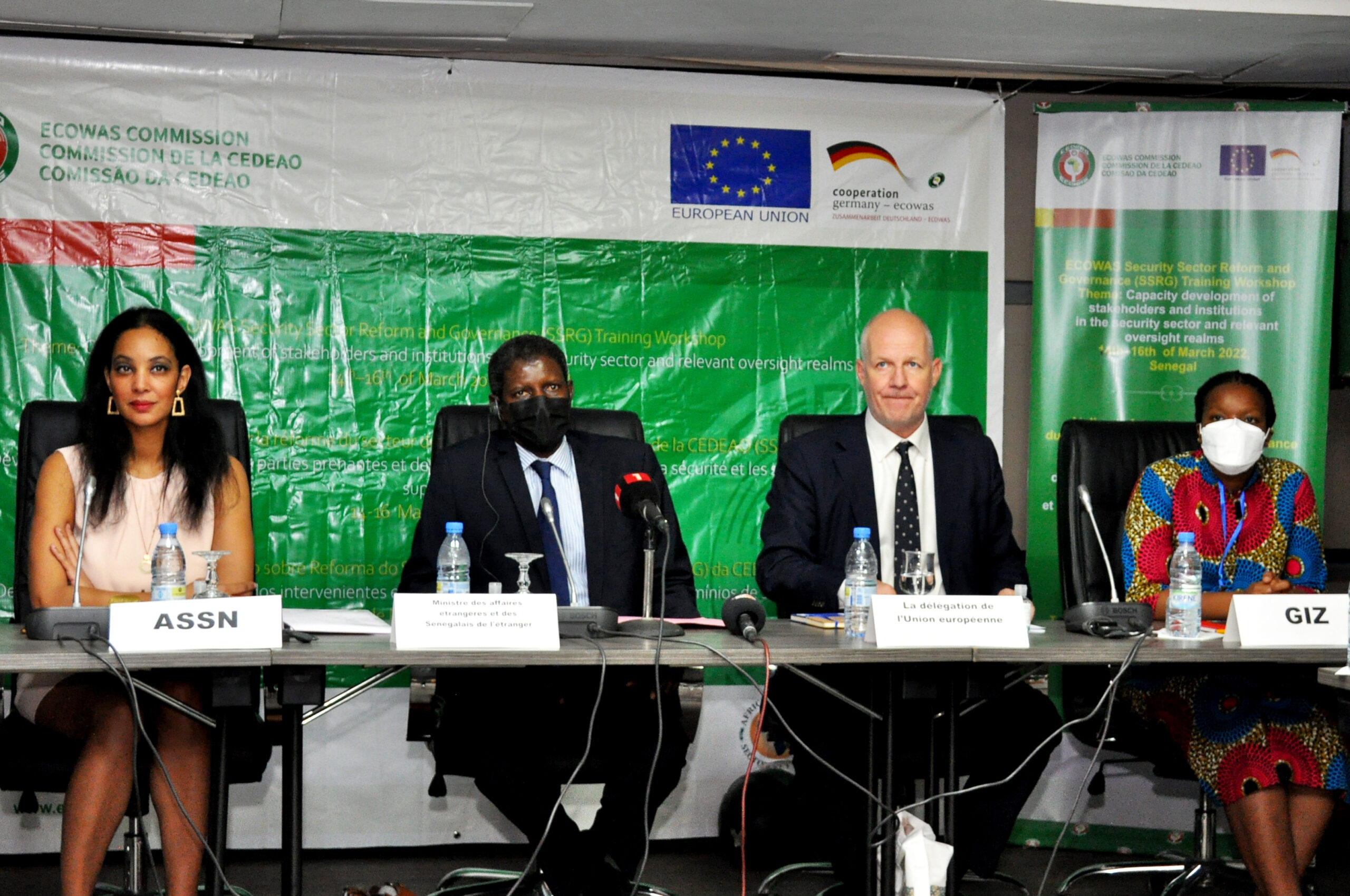
Chair of the ASSN, Dr Niagalé Bagayoko, provided insight into the formation of the ASSN, its nature and structure as well as it operations. She thanked the EU and GIZ for their unflinching support in the dissemination of the ECOWAS Policy Framework on SSRG. She detailed ASSN’s involvement in the drafting of the ECOWAS Policy Framework SSRG and lauded its adoption in 2016 and launch in 2021. She applauded ECOWAS for its efforts at conflict prevention but noted the need for ECOWAS to acknowledge that some of the institutions and regional security instruments have been overtaken by time because, the type of conflicts confronting the region at the moment is not the same as in the past. Thus, there is a need to enrich and reform the framework proactively. In conclusion, Dr Bagayoko stressed that the panacea to the plethora of security challenges confronting Africa lies in the hands of Africans themselves. She expressed hope that the workshop will not only contribute to the dissemination of the policy but also enrich it on the basis of unique national experiences. She encouraged participants to view the training experience as one of mutual enrichment and called on their cooperation in achieving the objectives of the workshop.