
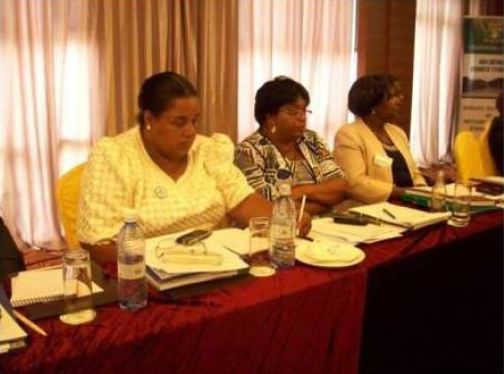
A section of the women parliamentarians at the SSG Executive Course in Lilongwe
1 November 2012
LILONGWE, Malawi – The Southern African Defence and Security Management Network (SADSEM) has relocated its secretariat to Mzuzu University in Malawi, moving from its base at the University of the Witwatersrand in Johannesburg, South Africa, where it has been located since the network’s inception in 2000. The secretariat’s new home is the Centre for Security Studies (CSS) at Mzuzu University, from where it will also continue coordinating the ASSN’s Southern Africa regional chapter.
The CSS is a member of the SADSEM network. It was established in 2007 to facilitate interaction between the academia and the security sector in Malawi. The Centre has primarily pursued this objective through the delivery of academic programmes such as its undergraduate programme in Security Studies and executive courses on topical issues in defence and security, including parliamentary oversight of the security sector, civil-military relations and security sector governance.
These executive courses are typically short training programmes tailored to suit executives and other key officers who are tasked with policy formulation and decision making in the security sector.
One such executive course on Security Sector Governance (SSG) was conducted on 24-28 September 2012 at the Golden Peacock Hotel in Lilongwe, Malawi, organised by SADSEM and the CSS with funding support from the Open Society Initiative for Southern Africa (OSISA). The course was conducted to meet the increasing demand by security sector officers, senior government officials, academics and civil society leaders for capacity building in the oversight of defence and Security functions. Its broader purpose was to help strengthen democracy and good governance of the Security Sector and contribute towards a peaceful, conflict free environment in Malawi by drawing on global and continental trends.
The course also offered an opportunity for the security sector to interact and reflect on what needs to be done to entrench democratic governance that involves the security sector in Malawi. Participants in the course were drawn from a cross-section of the Malawi society, including the Malawi Defence Force, the Malawi Police Service, the Immigration Department, the Prison Service, the Malawi Anti-Corruption Bureau, the National Intelligence Bureau, the National Assembly, the Judiciary, the Ministries of Defence, Home Affairs, Foreign Affairs, Energy Mining and Natural Resources (geological surveys), media houses, academia and the civil society.
The course opened with a welcome speech by the Acting Deputy Vice Chancellor of Mzuzu University, Professor Joseph Uta; an opening speech delivered on behalf of the Minister of Defence by the Principal Secretary in the Malawi Ministry of Defence and Security, Mr. Patrick Kachimera; and a keynote address from the Chair of the Southern African Defence and Security Management (SADSEM), Professor Anthoni Van Nieuwkerk.
Proceedings over the five days were interactive, involving themed presentations by experts from the various security agencies, plenary sessions and participatory activities in pursuit of four objectives namely;
•To enhance capacity in democratic governance and oversight of the security sector in Malawi.
•To improve understanding of public policy and its applications to the Defence and Security environment.
•To improve understanding of political transitions, peacebuilding and reconstruction and their implications for the security sector.
•To improve and increase knowledge on budgets, oversight and financial accountability.
The course ended on September 28 with a closing address by Honourable Jean Kalirani, Chairperson of the Parliamentary Committee on Defence and Security.
Download Malawi SSG Course report (PDF)
In a separate contribution towards its vision for effective democratic management of defence and security in Southern Africa, SADSEM collaborated with Friedrich Ebert Stiftung (FES) to hold the third annual Southern Africa regional security dialogue in Maputo on 30-31 October 2012.
The annual regional security dialogue was established by members of the SADSEM and FES networks in the region – who include scholars, senior government and security officials and civil society actors – as a platform on which they could examine the peace and security challenges facing Southern Africa as a region. They also examined important security developments, and seek to provide the Southern African community with policy relevant research on defence and security issues, and to inform discourse on security in the region.
The 2012 dialogue brought together security experts and scholars from within the region to discuss contemporary security challenges to the southern African region. The following five themes were explored: the state of the security debate in Southern Africa; donors and NGOs as security agenda setters; regional security cooperation: the role of SADC; crisis management in Southern Africa; and the geopolitics of maritime security.
Meanwhile a report on a workshop on ‘Security, Defence and Gender Training and Education‘ by Pusetso Marapedi, held at the University of Botswana in May last year, is now available on the DCAF website here.
The workshop reviewed and made recommendations for the enhancement of gender issues in SADSEM’s academic and short courses and more widely in Southern Africa and provides a guide for future action. It was jointly organized by SADSEM and the Geneva Centre for the Democratic Control of Armed Forces (DCAF).