
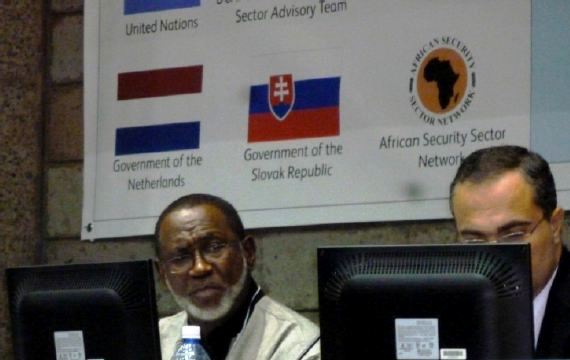
ASSN Chair Eboe Hutchful (left) at the High Level Panel on SSR in East Africa
2-3 October 2012
NAIROBI, Kenya – A two-day High Level Panel (HLP) on Challenges and Opportunities for Security Sector Reform (SSR) in East Africa was held on 2-3 October at the United Nations Office in Nairobi (UNON).
The HLP was organised in a partnership between the Embassy of the Slovak Republic in Nairobi, the African Development Bank (ADB), the UN, DCAF’s International Security Sector Advisory Team (ISSAT) and the African Security Sector Network (ASSN), as well as the Governments of Burundi, Kenya, Somalia and South Sudan, the African Union (AU), the East African Community (EAC) and the Inter-Governmental Authority on Development (IGAD).
Chaired by Dr. Michal Mlynár, Ambassador of Slovakia with Residence in Nairobi and Chair of the ISSAT Governing Board, the HLP brought together over 200 SSR policy makers and practitioners, senior government officials, regional and continental SSR experts, key donors, regional and multilateral organisations and representatives from among the Civil Society Organisations (CSOs). The ASSN was represented by its Chair, Professor Eboe Hutchful.
The central focus of the HLP was to consider the unique challenges and opportunities in engaging and supporting sustainable Security and Justice (S&J) programming in East Africa, as well as to share and identify best practices and lessons learnt from the region. The three case studies of Burundi, Somalia and South Sudan provided the core basis for the discussions, given the starkly different political, economic, social and security contexts in the three countries. The HLP also gave the AU Commission an opportunity to present the AU SSR Policy Framework.
Panellists and other participants discussed the opportunities, challenges and implications for the implementation of the AU SSR Policy, both for the African continent as a whole and East Africa in particular.
The importance of SSR to peace, stability and development was underscored at the HLP. It was recognised that beyond improving the delivery of Security and Justice (S&J) services to citizens, SSR should target the transformation of S&J institutions into more accountable, effective formations that are as critical in situations of post-conflict peace building and development as they are to the establishment of both short-term stabilisation and long-term stability. Rather than be perceived as a reactive process, SSR should also link with other sectors in identifying and addressing future security challenges, such as youth unemployment and conflict over resources.
Based on the three country case studies, the following lessons were drawn from the discussions at the HLP:
• National ownership is fundamental to sustainable and successful SSR. It provides legitimacy, and allows national priorities to uniquely shape the SSR process in each country context;
• Normative frameworks are a necessary tool in the process of guiding the SSR process because they ensure that the principles of accountability, effectiveness, respect for the Rule of Law and national ownership are embedded. One such tool would be the AU SSR Framework, which is adaptable to the country context and can be dovetailed with overarching security policy frameworks at the country level;
• Partnerships are very important for the delivery of SSR. These include strategic partnerships between countries and intergovernmental organisations such as the UN, AU, the European Union (EU), Regional Economic Communities, other regional organisations and entities, as well as greater South-South exchange of expertise/ skills, lessons learned, and good practices;
• The political nature of SSR: SSR is a political undertaking that requires technical capacity. As such, technical practitioners need the capacity to manage political challenges, such as the engagement of the political leadership, changing institutional cultures and vested interests, such as those of donors and multi-lateral partners;
• Political will: A strong political will is indispensable for SSR. It creates an understanding of what the SSR process will entail, the power shifts that may occur, the resources that must be allocated for the process, and the capacity to identify and involve people with longterm commitment and vision;
• Synergies: Successful SSR needs to resonate with the country’s development policy frameworks and create strong synergies between the actual security situation and related factors such as development, the Rule of Law and job creation. The link with public sector reform and expenditure should also be taken into consideration.
• SSR requires sustainable support: Donors need to ensure that the support they provide for SSR initiatives is sustainable and sufficient enough to facilitate the entire process all the way to completion.
Speaking at the HLP, Kenya’s Vice President, Kalonzo Musyoka, called on fellow East African leaders to support SSR, saying such reforms would enable regional countries to effectively guarantee the security of their respective populations.
The Director General of the United Nations Office in Nairobi (UNON), Ambassador Sahle-Work Zewde, pledged the cooperation of UN agencies with all the East African countries in the enhancement of peacebuilding, in partnership with the AU and other stakeholders.
Full Report of the HLP (PDF)
Listen to podcasts from the HLP (In English and French)