

Learn more about South Sudan
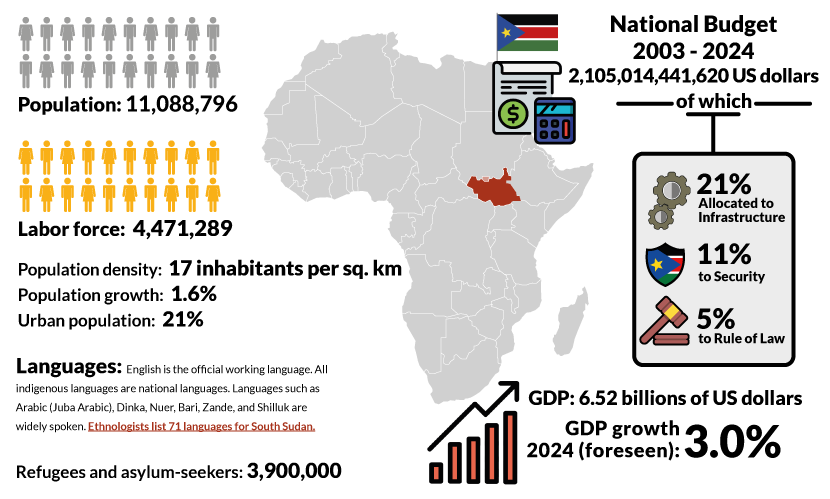
Source: Ministry of Finance and Planning, Approved Budget Fiscal Year 2023-2024 The Transitional Constitution of the Republic of South Sudan; World Bank; IMF;UNHCR (data as of July 2024).
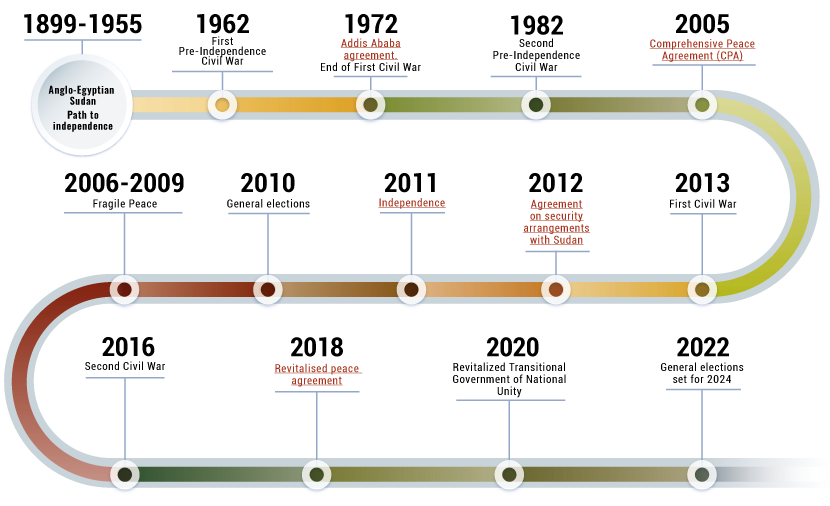
Key historical dates
Towards independence from Sudan
1899-1955
South Sudan is part of Anglo-Egyptian Sudan, under joint British-Egyptian rule.
1953
The Cairo Agreement is signed. It leads to the Sudan Self-Government Statute that paves the way for the election and the independence of Sudan.
The First Parliament is constituted. Twenty-two out of 97 seats are allocated to the South.
1954
The Sudanisation Committee of Public Service is appointed, without the participation of the South.
A leading Southern Sudanese Liberal Party organises a conference in Juba to demand federal status for the South after achieving independence.
1955
The Sudanese Parliament votes unanimously to complete the evacuation of foreign troops and consecrate its full independence. The vote comes with the demand that the South´s self-rule be considered after achieving independence.
Torit Mutiny. Southern Sudanese officers serving at the military barracks of the Equatoria Corps rebel against the British Administration.
1956
First Sudan Civil War
1962
A civil war, led by the Southern Separatist Anya Nya movement, erupts.
1969
A group of socialist and communist Sudanese military officers, led by Colonel Jaafar Muhammad Numeiri, seizes power. A policy of autonomy for the South is outlined.
1972
A peace agreement is signed in Addis Ababa: the Sudanese government concedes a measure of autonomy for Southern Sudan.
1978
Oil is discovered in Southern Sudan (Unity State).
Second Sudan Civil War
1982
The Numeiri regime redraws the border and carves out the oil-rich areas of Unity State of Southern Sudan to be part of Northern Sudan.
1983
The Numeiri regime adopts Islamic Sharia laws and abolishes South Sudan’s autonomy.
Fighting breaks out again between North and South Sudan, under the leadership of John Garang's Sudanese People's Liberation Movement (SPLM), after Sudanese President Jaafar Numeiri abolishes Southern Sudan's autonomy.
1985
Senior military officers, led by General Abdel Rahman Swar al-Dahab, mount a coup against the Numeri regime and retains Islamic Sharia laws.
1986
Elections are held and coalition government is formed headed by Prime Minister Sadiq al-Mahdi of the Umma Party.
The SPLM and a number of Sudanese political parties meet in Ethiopia and agree to the "Koka Dam Declaration”, which called for the abolishing of Islamic Sharia law, and convene a constitutional conference.
1988
The SPLM and the Democratic Unionist Party (DUP) – part of Sudan's ruling coalition elected government – agree on a peace plan calling for the abolition of military pacts with Egypt and Libya, freezing of Sharia law, end to the state of emergency, and ceasefire. It is not implemented because it is rejected by the Umma Party of the Prime Ministry.
Famine occurs in Bhar el Ghazal and claims an estimated 250,000 lives.
1989
Military officers under Col. Omar Hassan al-Bashir seize power, with National Islamic Front (NIF) instigation and support.
1991
The Bashir regime introduces harsh Islamic Sharia law. Southern states are exempted but with a possible future application of Islamic Sharia law.
The SPLM splits, with Dr. Riek Machar and Dr. Lam Akol forming their own splinter faction – the SPLA-Nasir.
Machar's SPLA-Nasir, in concert with the Nuer White Army, carried out the Bor massacre, killing an estimated 2,000 Dinka civilians.
1992
William Nyuon Bany forms a second rebel faction.
1993
Kerubino Kuanyin Bol forms a third rebel faction.
The three rebel factions announce a coalition of their groups called SPLA United at a press conference in Nairobi, Kenya.
Pockets of famine occur in Jonglei state.
1994
The Intergovernmental Authority on Development (IGAD) promulgates the Declaration of Principles (DOP) that aims to identify the essential elements necessary to a just and comprehensive peace settlement in Sudan.
SPLA United changes its name to South Sudan Independence Movement/Army (SSIM/A).
SPLM-Torit organizes its first convention – known as the “Chukudum Convention” – to replace the military administration in the areas under their control, with civilian administration.
1995
The major opposition parties in the north, led by the DUP and the Umma parties, unite with other parties from the south led by the SPLM, and create a coalition of opposition parties called the National Democratic Alliance (NDA).
1997
Seven Southern groups in the government, led by Dr. Riek Machar, sign the Khartoum Peace Agreement with the NIF-led national government, thereby forming the largely symbolic South Sudan Defence Forces (SSDF) umbrella.
The Sudanese Government signs the Declaration of Principles after major battlefield losses to the SPLA.
1998
Famine is declared in the areas under the control of the SPLM in the Bahr el Ghazal region; it claims about 70,000 lives.
2001
Sudanese Islamist leader Hassan Al-Turabi's party, the Popular National Congress, signs a memorandum of understanding with the southern rebel SPLM. Mr Al-Turabi is arrested the next day.
2002
John Garang and Riek Machar reconcile, and Machar is brought back to the SPLA.
Talks mediated by IGAD in Kenya lead to the signing of a breakthrough Machakos Protocol Agreement between the SPLM and the Sudanese government on ending the civil war and providing the South the ability to seek self-determination after six years.
Sudan Comprehensive Peace Agreement (CPA)
2005
The Sudanese Government and the SPLM sign the Comprehensive Peace Agreement (CPA), ending the civil war and providing for a permanent ceasefire, autonomy for the south, power-sharing, wealth-sharing, security arrangements and resolution of conflicts in the three areas of Abyei, Southern Kordofan and Blue Nile. It also establishes a south Sudanese referendum on independence in six years' time.
A new Sudanese Constitution which gives the South a large degree of autonomy and right of self-determination, is signed.
Former southern rebel leader John Garang is sworn in as the first vice-president and president of the Government of Southern Sudan. The Transitional National Government is formed.
The Interim Transitional Constitution of Southern Sudan is signed.
South Sudanese leader John Garang is killed in a plane crash and is succeeded by Salva Kiir Mayardiit.
An autonomous government is formed in South Sudan, in line with the January 2005 peace deal. The administration is dominated by former rebels.
Fragile Peace
2006
Hundreds die in fighting centered on the southern town of Malakal – the heaviest between northern Sudanese forces and former rebels since the 2005 peace deal.
Juba Declaration on Unity and Integration of the Sudan People’s Liberation Army (SPLA) and the South Sudan Defence Forces (SSDF) is signed.
2008
Tensions rise over clashes between Sudanese armed forces and SPLA in the disputed oil-rich Abyei area on the north-south divide – a key sticking point in the 2005 peace accord.
The SPLM Second National Convention convenes but it is marked by a divisive competition for the leadership of the party, particularly between President Salva Kiir and Vice President Dr. Riek Machar.
The Sudan 5th Population and Housing Census is conducted in all states of Sudan, including Southern Sudan: https://nbs.gov.ss/publications/southern-sudan-counts-tables-from-the-5th-sudan-population-and-housing-census-2008/
2009
The governments of Sudan and the Southern Sudan accept the ruling by the arbitration court in The Hague on the area of the Ngok Chiefdoms transferred from south to northern Sudan in 1905.
2010
General elections are held, with President Salva Kiir and his party, the SPLM, overwhelmingly winning at all levels of government in Southern Sudan. His vice, Dr. Riek Machar, is his running mate.
The new Cabinet is formed primarily from the SPLM members and is headed by President Salva and Vice President Dr. Riek Machar.
Independence Referendum
2009
Leaders of the North and South in the National Parliament pass the Referendum Act, defining the terms of a referendum for the people of South Sudan and of the Abyei area.
The African Union establishes the High-Level Implementation Panel for Sudan (AUHIP) with a mandate to facilitate the Sudanese parties in their implementation of the Comprehensive Peace Agreement.
2011
The people of South Sudan vote overwhelmingly (98%) in favour of full independence from Sudan. The referendum for the people of Abyei is denied by the Sudanese government.
The Sudanese government occupies the disputed border region of Abyei.
The governments of the north and south sign an accord to demilitarise the disputed Abyei region and allow in an Ethiopian peacekeeping force. The UN Security Council, by Resolution 1990, establishes the United Nations Interim Security Force for Abyei (UNISFA).
New State of South Sudan
2011
July 9: Independence Day; South Sudan becomes the 193rd member of the UN and 54th member of the African Union (AU).
Through Resolution 1996, the UN Security Council establishes the United Nations Mission in South Sudan (UNMISS) under Chapter 7 of the United Nations Charter for an initial period of one year. Its mandate is to consolidate peace and security, and to help establish the conditions for development in the Republic of South Sudan.
The UN Secretary General says at least 600 people are killed in ethnic clashes in Jonglei State.
South Sudan declares Jonglei State a disaster area after some 100,000 people flee clashes between rival ethnic groups.
2012
After weeks of border fighting, South Sudan troops temporarily occupy the oil field and border town of Heglig before being repulsed.
Some 200,000 refugees flee into South Sudan to escape fighting between the Sudanese army and rebels in Sudan's southern border states of Southern Kordofan and Blue Nile.
The presidents of Sudan and South Sudan agree on trade, oil and security after days of talks in Ethiopia.
2013
Sudan and South Sudan agree to resume pumping oil after a bitter dispute over fees that saw production shutdown for more than one year. They also agreed to withdraw troops from their border area to create a demilitarised zone.
The people of Abyei vote overwhelmingly (99%) in their self-organised community referendum to be part of South Sudan. Results are not accepted by the Government of South Sudan, the Government of Sudan and the African Union.
The SPLM convenes its National Liberation Council meeting to pass the basic documents of the party, including the draft constitution. Sharp differences prevail on the way of voting (secret vs. raising of hand), 5% seats of the Council to be appointed by the elected chairperson of the party and tenure of office of the chairperson of the party.
Senior leaders of the SPLM led by Dr. Riek Machar hold a press conference to annnounce their withdrawal from the meeting of the National Liberation Council (NLC), accusing South Sudan’s President and party chairman, Salva Kiir Mayardit, of deviating from the spirit of dialogue.
President Kiir dismisses the entire Cabinet and Vice President Riek Machar in a power struggle within the governing Sudan People's Liberation Movement.
First South Sudan Civil War
2013
Civil war erupts in uba as President Salva Kiir accuses his former vice president, Riek Machar, of plotting to overthrow him. Vice President Riek Machar had led a rebellion against President Salva Kiir after his dismissal.
The African Union Peace and Security Council establishes the Commission of Inquiry on South Sudan (AUCISS) mandated to investigate human rights violations and other abuses committed during the armed conflict.
2014
A ceasefire is signed but it is broken several times in subsequent weeks, and further talks in February fail to end the violence, displacing more than one million people by April.
Peace talks begin in the Ethiopian capital, Addis Ababa, and drag on for months, as fighting continues.
2015
The final report of the AU Commission of Inquiry on South Sudan (AUCISS) is released, finding evidence of widespread human rights violations committed by both the government and rebels.
President Salva Kiir and his former vice president and leader of the SPLM-In Opposition (SPLM-IO), Dr. Riek Machar, sign a peace agreement.
2016
Dr. Riek Machar finally returns to Juba and is sworn in as the first Vice President in a new unity government.
Second South Sudan Civil War
2016
Violent conflict erupts during a meeting between President Salva Kiir and Vice President Dr. Riek Machar in Juba, forcing Dr. Machar to flee the country to the Democratic Republic of Congo.
The UN replaces the UNMISS Force Commander over the failure to protect civilians in Juba during the July violence. Japanese peacekeepers arrive in South Sudan, marking the first time in nearly 70 years that Japan has deployed its soldiers overseas with a clear mandate to use force, if necessary.
The UN Commission on Human Rights declares that a process of ethnic cleansing is underway in several parts of the country.
2017
Famine is declared in parts of South Sudan in what the UN describes as a man-made catastrophe caused by civil war and economic collapse.
President Kiir declares a unilateral ceasefire and launches a national dialogue.
The number of refugees fleeing violence in South Sudan to Uganda exceeds the one million mark.
2018
President Kiir signs a power-sharing agreement with Riek Machar and other opposition groups in a bid to end the civil war. The deal provides for Dr. Riek Machar’s return to government as one of five vice presidents.
2020
The Revitalized Transitional Government of National Unity is formed and headed by President Salva Kiir and five vice presidents, with Dr. Riek Machar serving as the First Vice President.
2022
The parties to the 2018 Peace Agreement extend the agreement for an extra 24 months and also agree to hold general elections by December 2024.
The first promotion of the Necessary Unified Forces graduate.
2023
First deployment of Necessary Unified Forces
The 2012 National Elections Act is amended to pave way for the conduct of elections in 2024.
Rome Talks stall.
President Kiir reconstitutes National Elections Commission, Political Parties Council and Constitutional Review Commission.
UN raises concerns about the readiness of South Sudan to conduct credible elections and outlines important prerequisites to be met.
2024
South Sudan inaugurates the Elections Commission with analysts raising concerns about the Commission’s tight timelines and lack of adequate resources.
UN warns that South Sudan elections could result in disastrous consequences if not managed carefully.

